Feb 8, 2013

Cheese and Rice, Our Savior

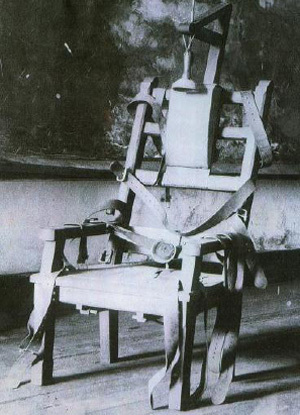
The Electric Chair was invented by a dentist.
First Electric Chair: Edison, Co.
Dr. Alfred P. Southwick, a pleasant dentist from Buffalo, New York, had witnessed a drunken man being accidentally electrocuted. He noted that the shock had delivered a quicker, less painful death than more popular gorey practices, the least grisly of which were strangulation with an iron collar, hanging and beheading. What followed was the invention of the electric chair.
Andy Warhol's Big Electric Chair
But how to market it? How do you relay the concept of such a horrific tool to the general public? How do you justify it to yourself? There must be some sort of separation between you and the dread thing. Luckily, there are handy linguistic games we play with ourselves that serve the purpose, two favorites being euphemism and nicknaming. During the first several years, most electric chairs were pet-named "Old Sparky," but a few, more colloquial monikers emerged. Louisiana coined "Gruesome Gertie," Indiana had "Old Betsy," and Pennsylvania, New Jersey and Tennessee preferred 
"Old Smokey."

"Woah," doesn't quite cover it. "Jesus Christ!" might be an appropriate response. But, if you didn't want to holler the Lord's name in certain company, reactions could employ a similarly avoidant linguistic tactic called a minced oath. Cheese and Rice, Jiminey Cricket, Gee Willikers, or Bejabbers could stand in.

The general category of silly words or phrases that act in place of actual, dictionary-approved ones provides an opportunity to be indirect, diplomatic, disrespectfully (some feel) distant from religious or historic significance.  It is a privileged fact of our complex language that we can say something other than exactly what we mean, and it can be mutually understood. English has no authoritative body governing "correct" usage, unlike French (Académie française), Italian (Accademia della Crusca), Icelandic (Íslensk málstöð), and Spanish (Real Academia Española). But what happens nonetheless is that the more the silliness is agreed upon, the closer it comes to being absorbed into the vernacular.

The more well known Cockney slang is replete with this type of accepted terminology (we'll keep them clean, here):
          trouble and strife = wife
          Eiffel Tower = shower

50's Diner slang has its own as well:
         Gimme two on a raft and wreck 'em - with a life preserver in the margins =
         I'd like two scrambled eggs on toast, bagel on the side, please.

This practice has a long history. In Greek mythology the king Rhadamanthus imposed on the Cretans the law that men should not swear by the gods, but by the dog, ram, goose, and plane-tree. In Shakespearean England, swearing on stage was banned, and thus all parts of the deity's self were covered by minced oaths: 'swounds (God's wounds), 'struth (by God's truth), 'sfoot (by God's foot), and gadzooks! ("God's hooks," referring to the nails in the cross).

Nicknames, euphemisms, minced oaths - a sprightly hop away from a direct expression of reality. In our least palatable efforts, we employ them to obscure abhorrent fact. Alternately, they act as an important reminder that there are multiple ways to express reality; language, and therefore meaning, are malleable. Humans are both figuring everything out, and making it all up, as we go along. OSLab celebrates this.
You say tomato...


Feb 1, 2013

Up from the Basement: A Shark, and Socrates

"Klaus Pichler was walking home late one night when he noticed a light on in the basement of Vienna's Natural History Museum. What he saw inside..."


...is documented in his Skeletons in the Closet. Pichler was given permission to photograph the corridors and closed off rooms of one of the oldest, largest history museums in the world. There he found a mesmerizing display, with a bloody, colonialist history. Specimens long since pillaged from other collections or plucked from the wilds of Africa and Asia were tucked, story untold, 
into basement rooms.


 images from http://www.fastcodesign.com/

Through Pilcher's photographs, the objects have been given a new context. They are fantastic, haunting, educational: an argument for preservation. But they beg a more philosophical turn. There needs to be some thinking about how a unique, thriving creature could have met its end at our hand, and why. 

In another museum, Socrates, long dead, is on trial again. 

Scholars have long been stymied by the details that led to his death sentence, and they're about to publicly rehash the whole affair. His first trial took place in Athens in 400 B.C.E. He was one of the greatest thinkers, teachers, and orators of all times, and lived in Athens, the world's foremost democratic citadel. His fellow citizens sentenced him to be executed. There had been no event, no crime per se. How could this have come to pass? The records, made fuzzy by the ambitions of those (Plato and Xenophon, foremost) who penned them, the differing interpretations of the philologists and historians who read them, and buffered by 2,000 years of competing interpretations, are not entirely reliable. But they do provide ample fodder for a debate.

Two days ago, the National Hellenic Museum in Chicago, IL called together cadre of "some of the country's foremost legal minds" including high profile lawyers and judges to give the trial another go. No word yet on the verdict, but we can quickly review the history while we wait.

The historic decision was made by 501 Athenian jurors (majority vote), no judge. They declared that Socrates should be executed, for "refusing to do reverence to the gods recognized by the city, and introducing other new divinities," and for "corrupting the youth." Recent interpretations hint of political intrigue - one of his star pupils turned out to be a horrifically violent enemy of democracy. 

It was the accused's responsibility to defend himself. He was also allowed to cross examine the accusers. Socrates, the arguer to beat all arguers, gave them a run for their money. First, he deftly divided the accusers into two groups - the original accusers, and the unenviable sheep who had become convinced by them...you see where this is going.

The Socratic Method considers inquiry to be a lifelong process, a way of being. Gregory Vlastos, a Socrates scholar and professor of philosophy at Princeton, describes it as, "among the greatest achievements of humanity," that "calls not only for the highest degree of mental alertness of which anyone is capable" but also for "moral qualities of a high order: sincerity, humility, courage." 
 Law students are forewarned that it may be employed by their professors, and may result in frustration. It exposes beliefs and biases, and allows for multiple viewpoints to be held in equal standing. Greek scholars call it elenchus (inquiry, cross examination) and it leads, Socrates submitted, to moral reform. He chose to die rather than forego its benefits and kneel before a linear prosecution.

Before the ancient trial took place, Chaerephon, an old friend of Socrates', went to the Oracle at Delphi to inquire if anyone was wiser than Socrates. The answer was a resounding no. When this was relayed to Socrates, he decided to cross examine friends and acquaintances - politicians, craftsmen, poets, sophists - who believed he, or themselves, to be wise. In the end, he determined that he was wiser than all of them. His stated reason:

...the fact is that neither of us knows anything beautiful and good, but he thinks he does know when he doesn't, and I don't know and don't think I do: so I am wiser than he is by only this trifle, that what I do not know I don't think I do. (p. 427)

You see, says he, a wise man is one who knows he is not wise. We in the OpenScienceLab agree. And the Buddha agrees. So there really is no way out of that one.

Jan 25, 2013

Did you see that?!...Pro'lly not


 “Adrift in an Arkansas swamp in February of 2004, a lone kayaker encountered what he believed could only be a figment of his imagination, an enormous black and white bird that had been declared extinct in North America for over fifty years...”  


                                             image from: www.smithsonianmag.com

Thus begins the documentary Ghost Bird, described in the NYT as, “a multilayered story that will fascinate practically everybody…” It's true. Audiences are rapt, including documentary devourers, bird hobnobbers, citizen scientists, scientists, and those generally interested in the human condition. It's a haunting film. The mystery of the giant, Ivory Billed Woodpecker has an uncanny hold on the locals whose livelihoods rely on its legend, and the people who spend their days believing in and searching for it. Even science unfurls a human, vulnerable self, wherein believing in something that may never appear is not out of the question. 


If you scroll down the Cornell University Ornithology Lab's Q & A about their scientists’ involvement, they state that there was not enough conclusive evidence to continue the expensive search. But they, too, had been tramping about in the dim, crackling wood, heard the stories, saw the blurred, suggestive photos - and they support the hypothesis that the bird might still be out there...  

Moviegoers will wonder: Are the photos real? Does this mythical bird live? ...Or do some believers want to see it badly enough that suddenly, before their eager eyes, it materializes? Not only can humans deftly omit or augment perception until a thing seems as we wish it to be; if prompted, we can see what may not be there at all. There are several factors involved here. The psychological piece, which is quite complex, is known in overly-simple terms as self-deception, rationalization, and the holding of contradictory beliefs, and we are often guilty of all of them. Even at the purely physical level, the phenomenon is also straightforwardly a function of optics: visually, when our blind spot leaves information out, our eye happily steps in to fill in the blanks. 


Can we overcome our more myopic traits and see what is really there? The history of science contains innumerable attempts to perfect the art of perception, discern thought from reality, parse the visible from the invisible, and find what is true. The pursuit leaves us bereft of One Final Answer, still. But for now we are not beyond hope, as we are highly trainable. Our brains can be altered. One man who clearly knows how to do this is a detective and, fittingly, he is a figment of our imaginations.


The BBC's quirky, new Sherlock Holmes upholds the tradition of having the brilliant resident of 221 B Baker St. be annoyingly adept at illuminating all of the things we ordinary folks don't notice. 


Maria Konnikova's new book Mastermind is the most recent attempt to expose the Holmesian bag of cognitive tricks. Konnikova lays out recent discoveries in psychology to show us that there are ways we, too, could train ourselves to observe, rather than just see. Hers and previous books on the topic posit that very normal seeming activities - meditation, repetition, practice - have the potential to change how we take in information and store it in our brains. 

For those of you who are now chomping at the bit to get started altering your brains, we've found you a quick tutorial.


Here at OSlab, we're all for leaving a bit of mystery in the everyday. If we all train ourselves to see the same things, does it homogenize the observable world and sell it short?  Is it better to see what we want to see, each add our bit of individual flair?  This has its complications, too, we concede. Well, thanks to quantum physics, this may all be moot: perhaps there are already many versions of the world - wildly nature-red-tooth-and-clawing, sci fi or straight sci, beyond the imaginable -  despite us, simultaneously spinning.


Jan 18, 2013


A Great Day In Science for No Man, and Everyman 

A group of people, who do not claim to be professional scientists, have discovered thousands of astronomical objects including nebulas, supernovas, and galaxies.  They are part of a resurgent movement of "citizen scientists," who collectively increase knowledge on a broad spectrum of topics. Recently, one member of the citizen science site Zooniverse, saw something bizarre floating beneath a known galaxy, an odd green formation that stymied even the experts. 

NASA/ESA Hubble Space Telescope

It is now called Voorwerp (Dutch for "object"). Other "Zooites" found what they were calling "peas." The peas turned out to be new, small, round green galaxies that are believed to be the fastest creators of stars in the universe. 

Zooniverse Director Chris Lintott, an astronomer at the University of Oxford, commented, "It was easy to find 'peas' by computer once we knew they were there, but without the human factor we'd never have noticed them." 

Citizen Science, because it runs the gamut from bemused interest to rigor, has accumulated several epithets of late, including the somewhat unruly-sounding “Crowd Science,” the edgy "Street Science,"and the hip “Participatory Urbanism.” There is a folksy, social side to it - websites, meetups, and apps, including the recent SciSpy, through which you can share sightings you deem to be science-worthy. The photos/findings can be interesting, though at times dubious (fluffy cat, chicken in a backyard, someone's foot). Still, it's about noticing, and sharing. 

The more serious of the lot are truly interested in advancing science, and are of varying demographics and backgrounds. They are humble contributors, unlikely to be paid or credited for their work. They are part of a historic tradition that includes one of the oldest clubs to house citizen scientists: the British Royal Society (est. 1660). In its historic heyday, it included scientists and laypeople alike. One of the latter, Antoine van Leeuwenhoek, a linen draper and haberdasher, worked tirelessly at his trades until he had secured enough funds to devote more time to his two favorite hobbies - lens grinding (microscopes) and the subsequent studying of tiny objects. Then, for years, he wrote informal letters to the Society, contributing his findings.  He gave the first accurate description of red blood cells. His research refuted the theory of spontaneous generationHe helped lay the very foundations of bacteriology and protozoology. He was eventually invited to become an official Fellow.

The club is more selective now - professional scientists (or scientists "of eminence") only. Many have their discoveries listed alongside their names - penicillin, hydrogen, the planet Uranus.  They have contributed an astounding amount of knowledge to science, to the world. In 2012 they published a study on science as an open enterprise, stating that it, "should be bounded by considerations of quality, legitimate commercial interests, privacy and security." We agree that a closed society of such great minds advances the world of science - this particular one played a major role in engendering modern science - but there are some implicit tricky areas here. Science necessitates a large degree of agreement, and yet benefits greatly from multiple viewpoints (cultural, sociological, linguistic, etc). Science moves forward thanks to the lifetimes of hard work and focus of professional scientists, yet it benefits from co-creative dialogue that reaches beyond their peers, their conferences, their clubs. 

US Poet Laureate (2001-2003) Billy Collins wrote, in his poem Thesaurus, 

             ...I rarely open it, because I know there is no
             such thing as a synonym and because I get nervous
             around people who always assemble with their own kind,
             forming clubs and nailing signs to closed front doors…

How we create and share information is who we are, and vice versa. This begs the questions: Which (cultural, social, linguistic, academic) umbrella do you place yourself under, which organized effort to you support, what club do you join, when you do your science? 

...And our pick this week for most intriguingly named Citizen Science project: The Mastodon Matrix Project

images from http://science.nasa.gov/media/medialibrary/2011/04/22/peas_strip.jpg

Jan 5, 2013

Bully for Hyperbole


Hyperbole's leanest definition might be "exaggeration." The Roman rhetorician Quintilian called it, "an elegant surpassing of the truth." It's Greek root, hyperballein, is "to throw over or beyond." It suggests a lifting, a fantastic flight. 

Recently, we became aware of twin sisters Margaret and Christine Wertheim, Directors of the Institute for Figuring, and their own use of the hyperbolic (the exaggerative and mathematical kinds). They wanted to increase global awareness of environmental threats to their beloved Great Barrier Reef.  They called for individuals and communities around the world to join them in solidarity, and in craft, and Hyperbolic Crochet Coral Reefs began to emerge.

                                                    images from www.crochetcoralreef.org


The collective Hyperbolic Crochet Coral Reef not only looks like a real reef, it has the same underlying geometry endemic to the ocean. Many marine organisms - kelps, corals, sea slugs, nudibranches - contain hyperbolic geometry in their anatomies. In her, A Field Guide to Hyperbolic Space:
 An Exploration of the Intersection of Higher Geometry and Feminine Handicraft

, Margaret Wertheim tells a backstory with gumption: 

“For two thousand years mathematicians knew about only two kinds of geometry – the plane and the sphere. But in the early nineteenth century they became aware of another space in which lines cavorted in aberrant formations. Offending reason and common sense, this new space came to be known as the hyperbolic plane. Although the properties of this space were known for 200 years, it was only in 1997 that mathematician Daina Taimina worked out how to make physical models of it. The method she used was crochet.”   

Science is an attempt to explain, in straightforward terms, the world we experience. Hyperbole blows the doors off of placid description. They are an unexpectedly fruitful pairing. Max Planck pictured gas molecules in our Sun behaving like little springs, oscillating away, each spewing forth specific colors of light. Einstein daydreamed about riding on a photon of light.  Jules Verne's science fictional Nautilus later inspired submarines and deep sea exploration. Between fiction and fact lie the slightly uncomfortable spaces where we are "thrown over and beyond," vaulted into wondering - if this is the Planet of the Apes, if firemen light fires or put them out, if we are Soylent Green.

In our research in the OpenScienceLAB we have learned that when people place themselves in somewhat of a fictional context, they are more able step outside of what they know or believe, be more imaginative and, importantly, listen to the ideas of others. Science benefits from this kind of letting go.

Over 5,000 people throughout the world have participated in the Hyperbolic Coral Reef thus far. Needles flying, they all responded to the plight of the reef. Through quirky, woolly craft, wild spires and fringe, they learned about its mathematical underpinnings.  "Offending reason and common sense," it was crochet that brought science to the masses.

Bully for you, me, and everyone who gets to experience this kind of science, Hyperbole.